In Search of Harmony
- Venue
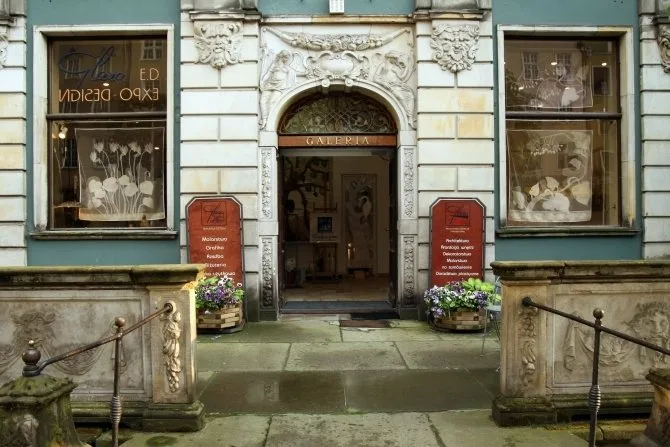
- Glaza Expo Design Gallery, Gdańsk, Poland
- Dates
- June 2006
Every Artist’s Dream
The dream of every artist is to exhibit their work in a prestigious gallery. Glaza Expo Design is a well-known name in the landscape of Tri-City galleries. This year, it celebrates its 15th anniversary. I would like to invite you and encourage you to visit the exhibition of the young artist Ewa Kalińska.
The artist works in painting and drawing. For several years, she has also been engaged in artistic textiles, which are the main theme of this exhibition. Kalińska’s favorite technique is appliqué—it allows her to best express her emotions. She has always been a keen observer of artists and has drawn inspiration from the world around them. Some have strived to depict its beauty with the highest level of precision, while others have sought to convey their personal impressions when faced with nature. For Ewa Kalińska, botanical motifs have become dominant in her creative work, filling her pieces with rich natural forms. Her technical proficiency is evident in her works, as she continually searches for new, compelling ways to shape her textile compositions.
At this point, I am reminded of a passage from an exhibition catalog about Józef Wilkoń:
“When an ordinary artist draws a horse, they focus on ensuring that the animal has four legs, a mane, and a tail. Józef Wilkoń, however, can make that horse neigh, appear slightly melancholic, and savor eating hay under the moonlight. Looking at his phenomenal works, one cannot shake the impression that his art is about something far greater than just a skilled hand and talent—it is about a sharp eye and profound observation.”
The same can be said about Ewa Kalińska—she strives for that “something more.”
From its very origins, textile art has been based on a rigid structure of interwoven vertical and horizontal threads, a technique that has remained unchanged for centuries. However, in contemporary times, textile art has undergone a transformation. It has become a defining element of modern artistic expression.
One manifestation of this artistic evolution is the attempt to redefine textile forms. The texture of fabric has become a dominant means of artistic communication. Open weaves, fiber combing, and similar techniques are used to break the conventional boundaries of the genre. Works are emerging that reveal a fascination with three-dimensional forms and the interplay of textiles with architectural spaces. Ewa Kalińska draws upon these innovations.
I would like to congratulate the artist on her perseverance in mastering this meticulous craft. However, despite the labor-intensive nature of her process, her works radiate lightness and elegance. Her drawings display a subtle precision, and her refined compositions reveal the sophistication of her artistic vision.
Marek Model, 2006
The Art of Everyday Beauty
The question of beauty in our everyday objects should be rhetorical—everything that surrounds us, everything we interact with daily, should be not only functional but also aesthetically pleasing. In this light, Ewa Kalińska’s artistic vision belongs to the highest echelon of art.
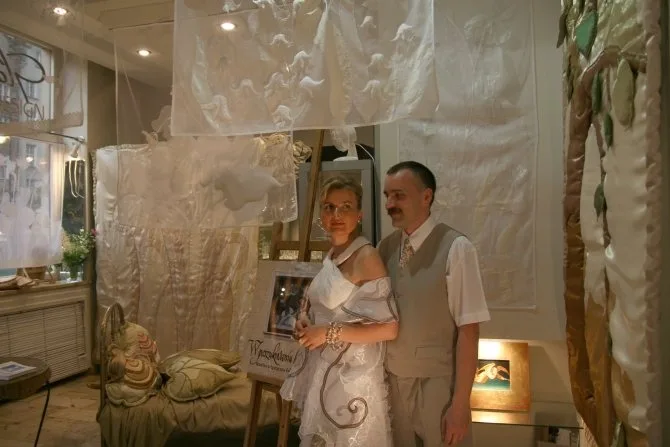
Her latest exhibition presents three intricately composed elements of home décor, yet they take on entirely new roles and arrangements. Let us call them, symbolically, “windows,” “coverlets,” and “pillows.”
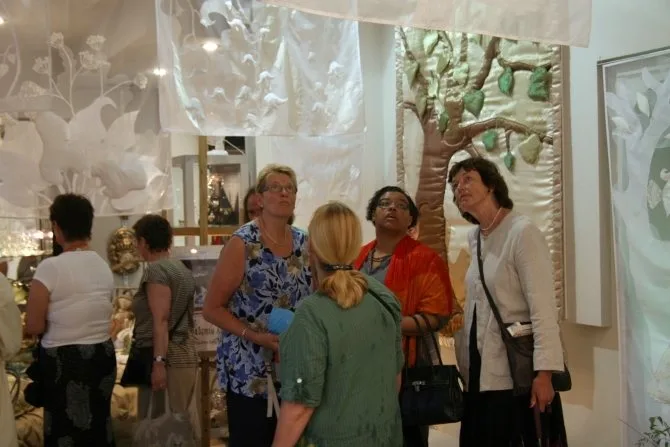
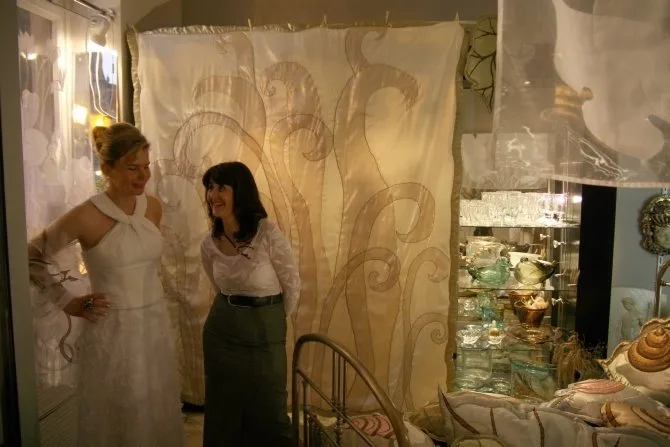
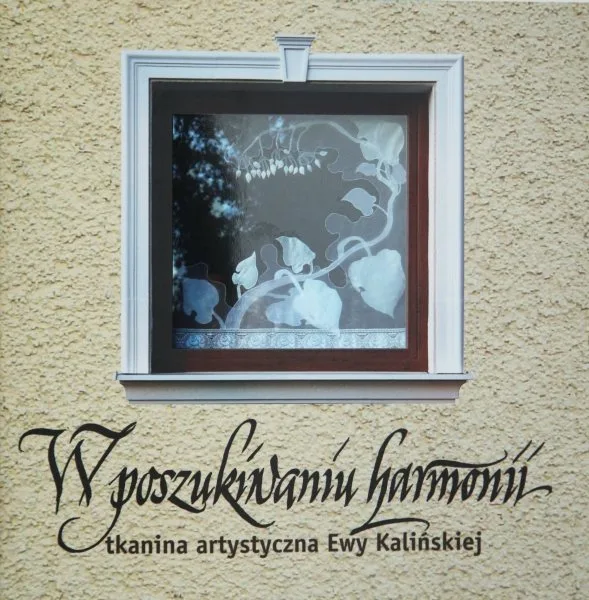
The “windows” are remarkable canvases, framed not by wood but by the walls of a home. They depict plants commonly found in our backyards, meadows, and gardens. The entire composition is rendered in a single color—white. However, one would be mistaken to assume that white lacks expressive potential. These works demonstrate the astonishing variety of white shades, all determined by the materials used to create each pattern. Some flowers, such as bellflowers, appear as small, soft cushions. Butterflies, delicately embroidered and attached to mesh, seem to hover above the blossoms as if they were alive.
But let us not forget that these are windows—they must lead outward, not obscure the view. This is why certain elements appear to be woven from mist, while others emerge from it, seemingly peering into our homes—not intruding upon our intimacy but rather guarding its warmth and privacy from the outside world.
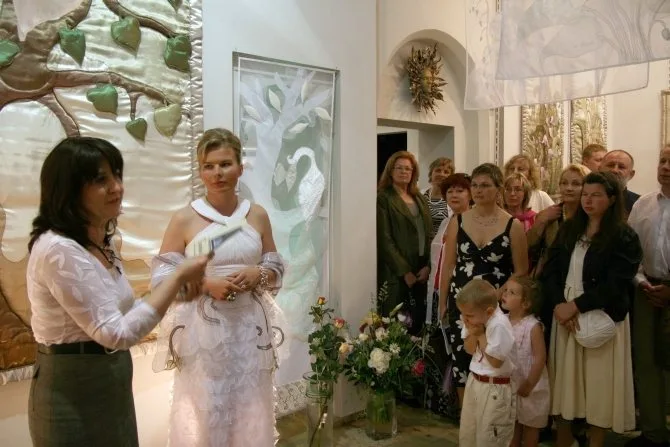
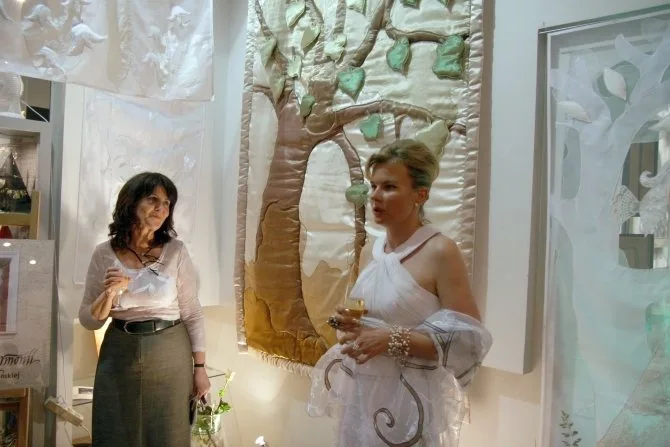
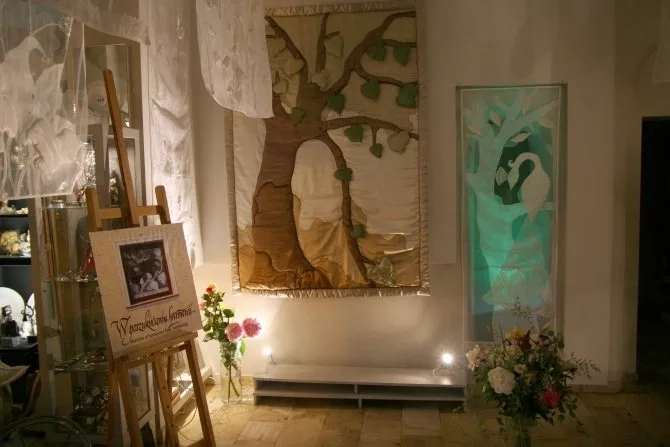
In contrast, the “coverlets” are full of vibrant colors. Their applications are diverse—they may be draped over a bed, placed on the floor as a decorative rug, or best displayed as wall hangings. Their color palette is drawn from the earth—soft greens and browns contrast beautifully with the delicate purple of bellflowers that peek from these textile tapestries. Another coverlet features a majestic tree, inviting the viewer to step into an enchanted forest.
The collection is completed by “pillows”—delicate fabric leaves and spirals that immediately evoke the poetic imagery of Mickiewicz’s verse:
“Escape with your soul onto a leaf.”
And indeed, looking at these pieces, one feels as if the tiny snail resting on the leaf is about to slide off and embark on a journey across the room.
To make our home beautiful, we can hang paintings, purchase elegant furniture, and cover our floors with expensive rugs. But to give it soul, we need something beyond mere objects—we need the hidden essence of Art within them.
Magdalena Tomkowska, 2006
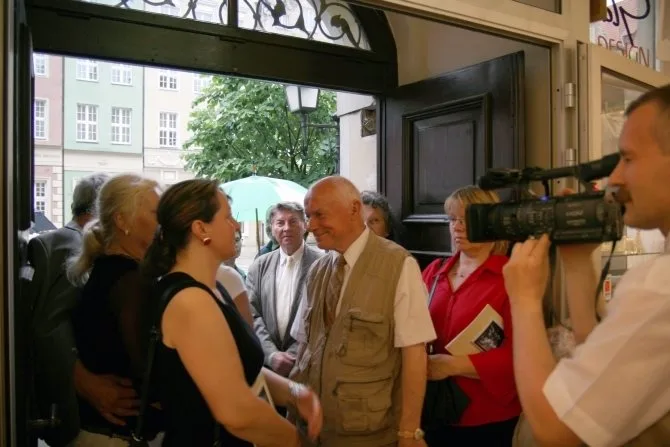
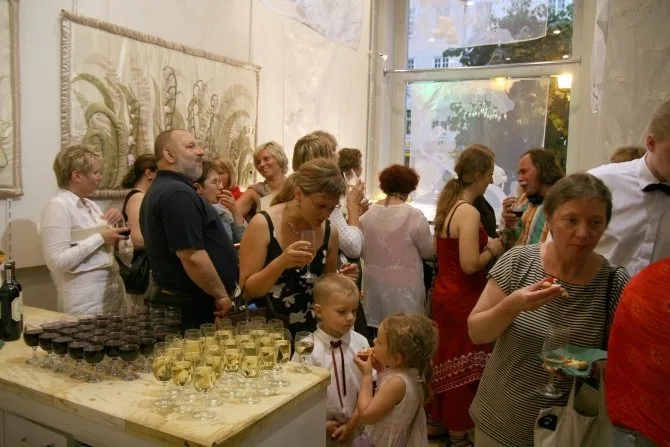
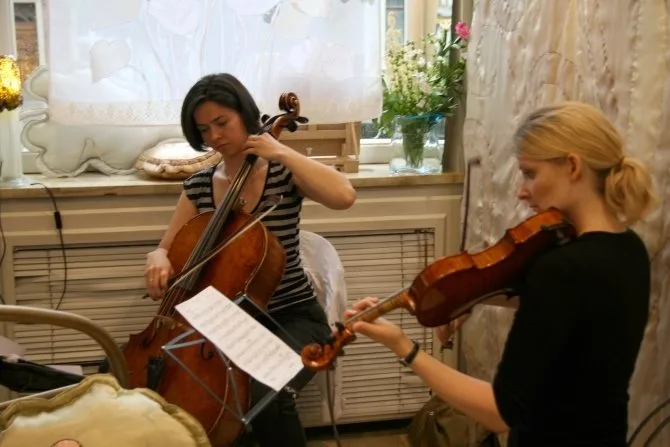
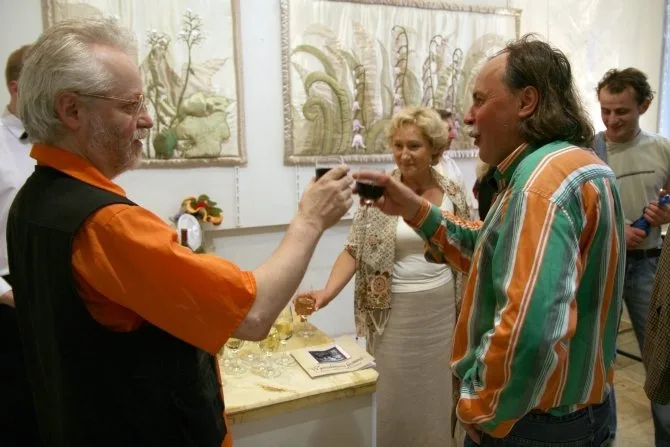
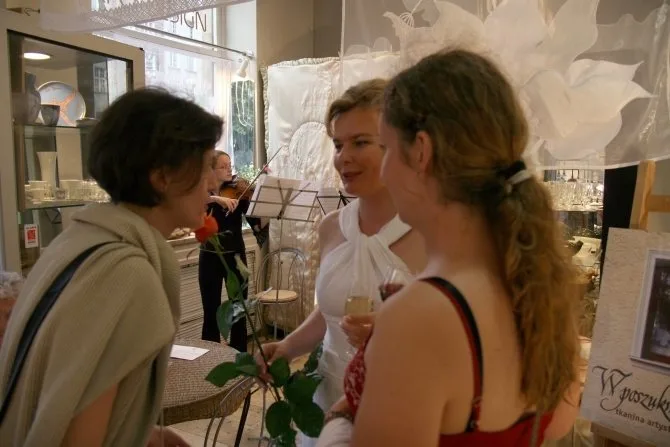
Exhibition photos